

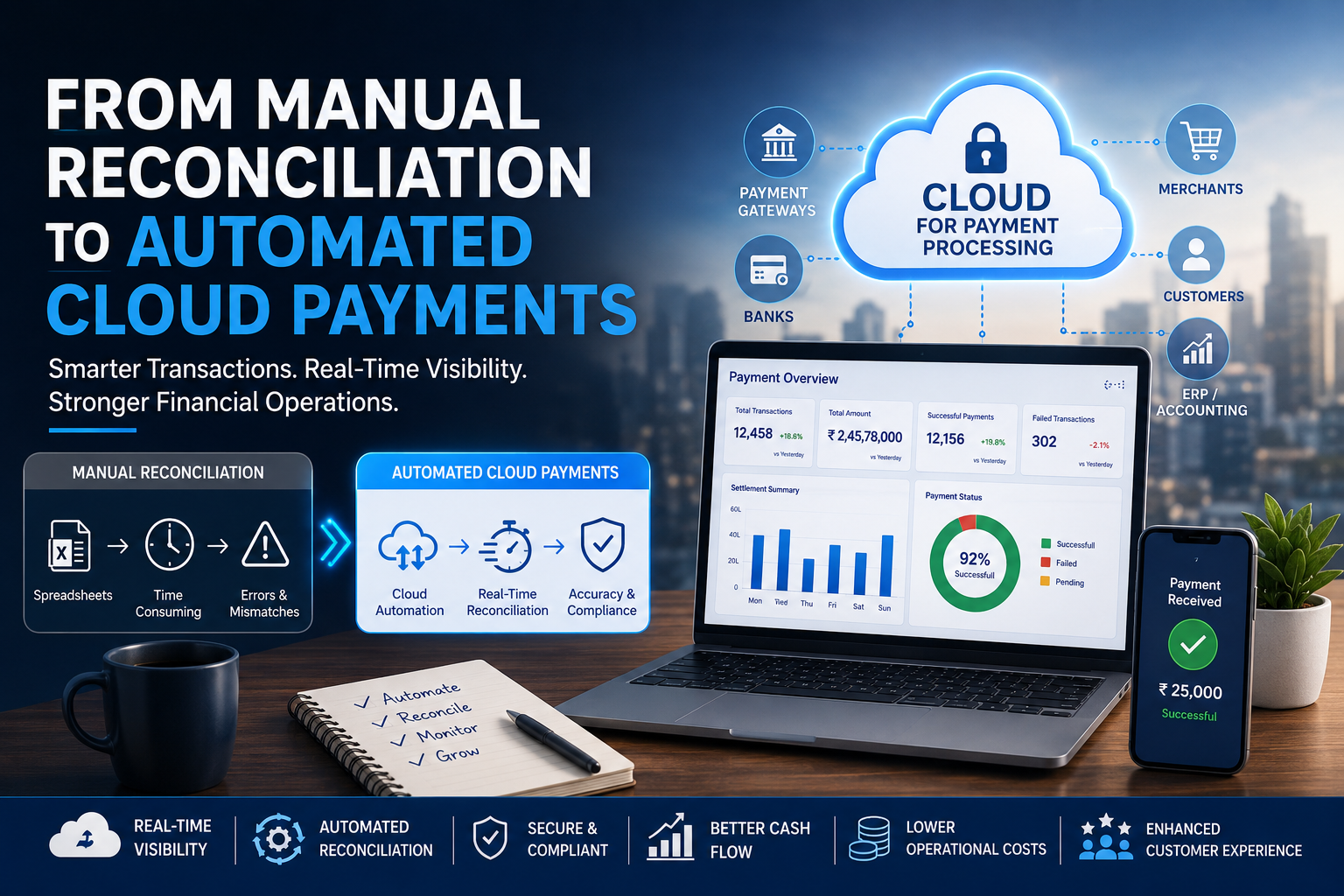
Cloud for payment processing is one of the most critical functions inside any organization. Every invoice, customer payment, vendor transaction, refund, subscription charge, and bank settlement directly affects operational stability and financial visibility.
Yet many businesses still manage payment reconciliation using highly manual processes.
Finance teams download spreadsheets from multiple payment gateways, compare transaction records manually, verify settlements one by one, identify mismatches, update ERP systems, prepare reports, and communicate with banks or vendors whenever discrepancies appear.
As transaction volumes grow, this process becomes slower, more expensive, and increasingly difficult to manage.
A single reconciliation delay can impact:
- Cash flow visibility
- Vendor payments
- Customer trust
- Financial reporting
- Audit readiness
- Business forecasting
This is why organizations are rapidly moving toward automated cloud for payment processing solutions.
Cloud for payment processing transforms reconciliation from a time-consuming financial task into a real-time automated workflow that improves accuracy, speed, scalability, and operational efficiency.
Instead of relying on disconnected spreadsheets and manual verification, businesses can centralize payment data, automate matching processes, monitor transactions instantly, and gain real-time financial visibility across operations.
The shift is not simply about faster payments. It changes how finance operations function across the organization.
Why Manual Reconciliation Creates Operational Problems in Cloud for payment processing
Manual reconciliation often begins as a manageable process when transaction volumes are low.
As businesses expand, payment ecosystems become more complex.
Organizations start handling:
- Multiple payment gateways
- Bank integrations
- Online transactions
- Subscription billing
- International payments
- Vendor settlements
- Refund management
- Wallet transactions
- UPI transactions
- Credit card payments
Finance teams then spend enormous time comparing records across systems.
Typical manual reconciliation workflows include:
- Exporting payment reports
- Downloading bank statements
- Matching transaction IDs
- Verifying settlement statuses
- Identifying failed transactions
- Investigating discrepancies
- Updating ERP systems manually
- Preparing reconciliation summaries
Even small mismatches can create significant operational delays.
A missing transaction reference, delayed settlement, duplicate entry, or failed payment may require hours of investigation.
As payment volumes increase, the process becomes difficult to scale efficiently.
The Real Cost of Manual Financial Operations
Manual payment reconciliation affects more than finance departments.
It impacts the entire organization.
Delayed Financial Visibility
When reconciliation takes days, businesses lose real-time visibility into incoming revenue and outgoing payments.
Increased Human Errors
Manual data entry creates risks such as:
- Duplicate records
- Incorrect amounts
- Missing settlements
- Spreadsheet errors
- Wrong account mapping
Slower Decision-Making
Management teams depend on accurate financial data for operational decisions.
Delayed reconciliation delays reporting accuracy.
Higher Operational Costs
Finance teams spend valuable hours on repetitive administrative tasks instead of strategic analysis.
Poor Customer Experience
Refund delays and payment verification issues negatively affect customer satisfaction.
The Shift Toward Cloud Payment Processing
Cloud payment systems centralize and automate financial transaction workflows.
Instead of processing payments through disconnected systems, organizations use cloud platforms that integrate:
- Payment gateways
- Banking systems
- ERP platforms
- Accounting software
- Billing systems
- Subscription platforms
- E-commerce channels
This creates a connected financial ecosystem where payment data flows automatically in real time.
Cloud payment processing helps businesses:
- Automate reconciliation
- Reduce manual workload
- Improve transaction visibility
- Monitor settlements instantly
- Improve reporting accuracy
- Scale operations efficiently
The transition from traditional reconciliation to cloud automation fundamentally changes finance operations.
Cloud for Financial Services and Fintech Platforms
Financial institutions are increasingly adopting cloud for financial services solutions to modernize banking and digital payment ecosystems.
Modern finance organizations require:
- Real-time transaction processing
- Intelligent fraud detection
- Secure payment infrastructure
- Scalable financial operations
- Faster reconciliation workflows
This has accelerated demand for advanced fintech cloud platform environments capable of supporting high-volume digital financial operations.
Banks and fintech companies are also investing in:
- AI-driven payment systems
- Automated compliance tracking
- Intelligent risk management
- Multi-channel transaction visibility
Cloud-powered financial infrastructure enables organizations to operate faster while improving scalability and operational security.
Cloud Compliance and Risk Management for Banking
Regulatory compliance remains a major concern for financial institutions.
Modern cloud systems help banks improve:
- Transaction traceability
- Audit readiness
- Fraud monitoring
- Access control
- Regulatory reporting
This is why businesses increasingly adopt cloud compliance for banks and cloud risk management finance solutions.
Cloud-based compliance automation improves operational transparency while reducing manual governance workloads.
Wealth Management and Loan Processing in the Cloud
Financial organizations handling investment and lending services are rapidly adopting cloud platforms.
A modern wealth management cloud platform helps organizations:
- Monitor investment portfolios
- Track customer financial activity
- Improve reporting visibility
- Secure sensitive financial information
Similarly, businesses offering lending services use cloud for loan management systems to automate:
- Loan approvals
- Payment tracking
- Interest calculations
- Customer communication
- Risk analysis
Cloud-based automation improves both operational speed and customer experience.
What Is Automated Cloud Payment Processing?
Automated cloud payment processing refers to using cloud-based platforms to manage, verify, reconcile, monitor, and process transactions automatically.
Instead of manually comparing records, intelligent systems automatically:
- Match transactions
- Detect mismatches
- Validate settlements
- Trigger alerts
- Update ERP systems
- Generate reports
- Process approvals
These platforms operate continuously with real-time synchronization across financial systems.
The result is faster and more reliable payment operations.
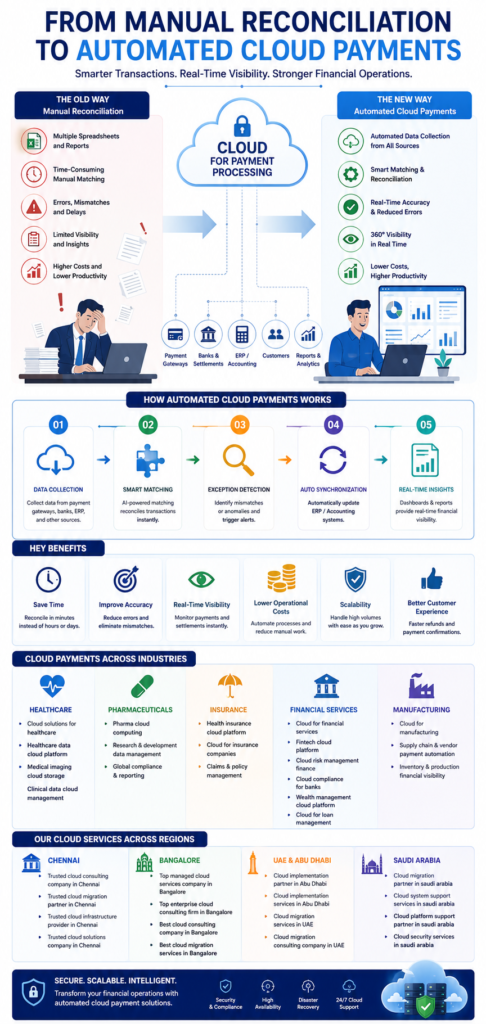
How Automated Reconciliation Works
Automated reconciliation systems use predefined logic and intelligent matching engines to compare payment records across systems.
The process usually works like this:
Step 1: Payment Data Collection
The system gathers transaction data from:
- Banks
- Payment gateways
- ERP systems
- POS systems
- E-commerce platforms
Step 2: Transaction Matching
The platform automatically compares:
- Transaction IDs
- Invoice references
- Payment amounts
- Settlement dates
- Customer details
Step 3: Exception Detection
If mismatches occur, the system flags exceptions automatically.
Step 4: ERP Synchronization
Validated transactions update accounting and ERP records automatically.
Step 5: Reporting & Insights
Finance teams receive real-time dashboards and reconciliation summaries.
This eliminates most repetitive reconciliation activities.
Cloud Solutions for Healthcare Payment Operations
Healthcare organizations manage highly sensitive financial and patient-related transactions.
Modern hospitals and healthcare institutions increasingly use cloud solutions for healthcare to improve operational efficiency and data accessibility.
Healthcare organizations require:
- Secure patient billing systems
- Insurance payment integration
- Clinical data accessibility
- Medical imaging storage
- Real-time financial visibility
Advanced healthcare data cloud platform solutions help centralize operational and patient information securely.
Healthcare providers also depend on:
- medical imaging cloud storage
- clinical data cloud management
- cloud-based patient billing
- automated healthcare reconciliation
Cloud systems improve operational coordination across healthcare ecosystems.
Pharma and Insurance Companies Are Moving to the Cloud
Healthcare and insurance industries are heavily investing in cloud infrastructure.
Modern pharma cloud computing platforms help pharmaceutical organizations manage:
- Research data
- Manufacturing operations
- Supply chain tracking
- Compliance workflows
- Global collaboration
Insurance providers increasingly rely on health insurance cloud platform solutions for:
- Claims management
- Customer policy tracking
- Payment processing
- Fraud analysis
- Digital service delivery
Cloud automation improves operational scalability across both industries.
Cloud-Based Payments Improve Scalability
As transaction volumes increase, manual reconciliation becomes unsustainable.
Cloud infrastructure supports scalability without requiring major operational changes.
Businesses can process:
- Thousands of daily transactions
- Multi-location payments
- Cross-border transactions
- High-volume settlements
without increasing manual workload proportionally.
This makes cloud systems ideal for growing businesses.
Organizations using cloud for insurance companies and digital finance ecosystems particularly benefit from scalable infrastructure.
Cloud for Manufacturing and Industrial Operations
Manufacturing companies also benefit significantly from cloud transformation.
Modern cloud for manufacturing platforms help organizations automate:
- Vendor payments
- Procurement tracking
- Supply chain visibility
- Production analytics
- Financial reconciliation
Manufacturers handling multi-location operations require centralized financial visibility and scalable transaction management.
Cloud platforms improve operational coordination across plants, warehouses, and supplier networks.
Cloud Security and Infrastructure Services
As businesses migrate financial systems to the cloud, security becomes increasingly important.
Organizations now invest heavily in:
- Secure cloud infrastructure
- Identity management
- Data encryption
- Threat monitoring
- Disaster recovery
Businesses in the Middle East increasingly seek cloud security services in saudi arabia to strengthen cybersecurity and compliance capabilities.
Companies also require:
- cloud system support services in saudi arabia
- cloud platform support partner in saudi arabia
- scalable cloud infrastructure
- enterprise cloud monitoring
Secure cloud environments are essential for financial operations and payment processing ecosystems.
Cloud Migration and Enterprise Transformation Services
As organizations modernize their IT ecosystems, cloud transformation has become a major priority for improving operational flexibility, security, and scalability. Businesses are no longer moving only applications to the cloud — they are redesigning entire digital infrastructures to support automation, analytics, ERP modernization, and intelligent financial operations.
Companies planning digital transformation initiatives often look for a trusted cloud consulting company in Chennai to help assess infrastructure readiness, optimize workloads, and build long-term cloud strategies. During migration projects, organizations also depend on a trusted cloud migration partner in Chennai to ensure smooth transitions with minimal operational disruption.
Modern enterprises require secure and scalable infrastructure environments that can support payment systems, ERP platforms, analytics tools, and customer-facing applications. This has increased demand for a trusted cloud infrastructure provider in Chennai capable of delivering reliable cloud architecture, backup systems, disaster recovery, and security management. Businesses also seek a trusted cloud solutions company in Chennai that can provide end-to-end cloud implementation, monitoring, optimization, and managed services.
In Bangalore, enterprises handling large-scale digital operations often collaborate with a top managed cloud services company in Bangalore to improve infrastructure performance, automate cloud operations, and manage enterprise workloads efficiently. Growing organizations also work closely with a top enterprise cloud consulting firm in Bangalore for advanced cloud architecture planning, hybrid cloud strategies, and multi-cloud integration support.
As cloud adoption accelerates, businesses continue searching for the best cloud consulting company in Bangalore to modernize legacy systems, improve operational agility, and support enterprise application migration. Organizations moving large databases, ERP systems, and financial applications also require the best cloud migration services in Bangalore to handle secure data transfers, infrastructure modernization, and cloud optimization projects.
Growing Demand for Cloud Services Across the Middle East
Cloud transformation is expanding rapidly across the Middle East as organizations modernize financial operations, ERP systems, and digital infrastructure.
Businesses implementing enterprise cloud environments often partner with a cloud implementation partner in Abu Dhabi to deploy scalable cloud platforms that support payment processing, analytics, and operational automation. Companies also invest in professional cloud implementation services in Abu Dhabi to improve infrastructure efficiency, business continuity, and application performance.
Across the UAE, enterprises are accelerating digital transformation initiatives through advanced cloud migration services in UAE that help organizations move workloads securely from legacy environments to modern cloud ecosystems. Businesses also seek support from a cloud migration consulting company in UAE for migration planning, compliance management, infrastructure assessment, and cloud governance strategies.
In Saudi Arabia, cloud modernization continues to grow across banking, manufacturing, healthcare, and enterprise sectors. Organizations increasingly rely on a cloud migration partner in Saudi Arabia to support ERP modernization, payment infrastructure upgrades, and secure enterprise cloud deployments.
The growing adoption of cloud technology across the region reflects the increasing demand for scalable, secure, and automation-ready digital infrastructure capable of supporting modern business operations.
AI and Automation Are Reshaping Payment Operations
Modern cloud payment platforms increasingly use AI-driven capabilities.
These include:
- Intelligent anomaly detection
- Predictive cash flow analysis
- Fraud monitoring
- Smart reconciliation logic
- Automated categorization
- Financial forecasting
AI improves payment accuracy while reducing operational effort further.
Organizations moving toward intelligent finance operations gain a significant operational advantage.
Real-Time Dashboards Improve Decision-Making
Cloud payment platforms provide centralized dashboards for monitoring financial activities.
Businesses can instantly track:
- Daily collections
- Pending settlements
- Revenue trends
- Payment gateway performance
- Failed transactions
- Customer payment behavior
This enables faster and more informed decision-making.
Faster Financial Closing Cycles
Month-end closing processes often become stressful because reconciliation remains incomplete.
Cloud payment automation accelerates:
- Transaction verification
- Ledger updates
- Settlement validation
- Financial reporting
This shortens financial closing cycles and improves reporting timelines.
Audit Readiness Improves with Automation
Audits require accurate transaction records and traceable financial histories.
Manual systems often create documentation challenges.
Cloud platforms maintain:
- Centralized transaction logs
- Automated histories
- Searchable payment records
- Approval tracking
- Activity monitoring
This simplifies audit preparation and compliance management.
Financial Operations Become More Predictable
Automation improves consistency across financial workflows.
Businesses gain:
- Standardized reconciliation
- Consistent reporting
- Reliable settlement tracking
- Faster issue resolution
This creates more stable and predictable finance operations.
The Future of Payment Processing Is Intelligent Automation
The financial operations landscape continues evolving rapidly.
Businesses increasingly expect:
- Instant reconciliation
- Real-time reporting
- Automated payment workflows
- AI-driven insights
- Intelligent anomaly detection
- Centralized financial visibility
Cloud payment automation is becoming a foundational part of modern business infrastructure.
Organizations relying heavily on manual reconciliation may struggle to scale efficiently in increasingly digital payment environments.
Conclusion
Manual reconciliation slows down financial operations, increases errors, and limits business visibility.
As transaction ecosystems become more complex, traditional payment workflows struggle to keep pace with operational demands.
Automated cloud payment systems transform financial operations by replacing repetitive manual work with intelligent, real-time automation.
Businesses gain:
- Faster reconciliation
- Better accuracy
- Real-time visibility
- Improved scalability
- Reduced operational costs
- Stronger financial control
- Faster reporting
- Better customer experiences
From payment gateways and ERP integration to AI-driven reconciliation and automated reporting, cloud payment processing creates a more efficient and scalable financial ecosystem.
Whether supporting healthcare systems, manufacturing operations, banking platforms, insurance companies, or fintech ecosystems, cloud infrastructure is becoming the foundation of intelligent financial operations.
The transition from manual reconciliation to automated cloud payments is no longer simply a technology upgrade.
It is a complete operational transformation that helps organizations move faster, operate smarter, and scale with confidence in a digitally connected financial environment.

